Sand Control Systems Market Innovations & Competitive Analysis – Forecast To 2032
Market
overview:
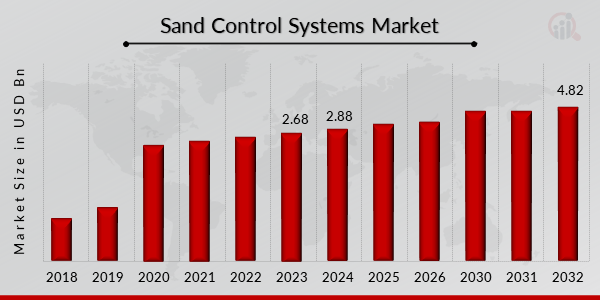
The sand
control system market will obtain a value of USD 4.82 Billion and a CAGR of
7.59% between 2023-2032.
The oil and gas
industry relies heavily on sand control systems. It is a cutting-edge technology
that aids in the filtration of sand residue in the wellbore. The sand control
system's activities are ideal for the oil and gas industry.
Sand Control
Systems are systems or equipment that aid in the removal of sand deposits and
their mixing during the hydrocarbon extraction process.
The system is
vital in the overall completion process since it improves a well's performance
and production. It aids in the eradication of sand generation in the wellbore.
The system is critical to the completion process since it restores the well's
performance and productivity.
The primary
factors driving the sand control solutions market growth are ongoing shale
development operations and efforts to raise the reserve to production ratio
from wells. The reserve to production ratio specifies how long a natural
resource will last at a particular output rate. Oilfield operators are focused
on older wells and improving the reserve to production ratio as crude oil
prices fall.
Furthermore, when
oil reserves diminish, major oil and gas firms have moved their focus to
technological breakthroughs to develop instruments and strategies for accessing
residual reserves on conventional wells. Oilfield service businesses are
currently focused on enhancing recovery and extending the life of mature
assets, resulting in higher production levels than normal.
Key
Players:
·
Schlumberger Limited
(France)
·
Halliburton Inc. (U.S.)
·
Baker Hughes Incorporated
(U.S.)
·
Weatherford International
(Switzerland)
·
National Oilwell Varco
(U.S.)
·
Oil States International
(U.S.)
·
Tendeka (U.K)
·
Welltec (Denmark)
·
Packers Plus Energy
Services Inc. (Canada)
·
Superior Energy Services
Inc. (U.S.)
Segmentation:
The sand
control systems market is divided into different segments such as:
By
type: The market is divided into two types:
open holes and cased holes. Due to technical concerns relating to the hole's
stability, cased-hole sand control technologies are more often adopted. The
production casing is put in the reservoir in a cased-hole completion, ensuring
safe production operations. It also serves as a barrier, keeping sediments,
undesirable fluids, and gases out of the wellbore.
By
technique: The market is divided into Gravel Pack,
Frac Pack, Sand Screens, Inflow Control Devices, and Others based on technique.
Gravel packing is useful for keeping sand from entering the production string.
By
application: The market is divided into two
categories based on application: onshore and offshore. Because of the large
number of onshore oil and gas wells, the onshore application had a larger
market. It increased reliance on traditional oil and gas, the most
cost-effective and easy option to meet energy demand. Onshore applications
often use gravel packs.
Regional
analysis:
Gravel packets
come in a variety of sizes and shapes. As per the reports of regional analysis,
the Global Sand
Control Solutions Market is classified into four regions: North
America, Europe, Asia Pacific, and the Rest of the World for onshore
applications. The North American region dominates the Sand Control Systems
market, followed by the Asia Pacific and North America. Market expansion
was aided by rising demand for oil output in the United States, Mexico, and
Canada. The demand for oil produced in the North Sea region is very high
throughout Europe. Saudi Arabia, Angola, the United Arab Emirates, and Nigeria
are among the largest oil-producing countries in the Middle East and Africa. As
a result, many investors are interested in Sand Control Systems.
Industrial
news:
Tendeka released a
one-trip remedial solution in December 2020 to address the issue of sand
control failure in wells. The Filtrex remedial sand control device can be used
through the tubing and under the most difficult circumstances. Sand cleaning
may be done as the tool is mounted, thanks to Filtrex technology.
Related Reports
Comments
Post a Comment