Global Industrial Air Compressor Market Trends, Growth Drivers, and Forecast
Market overview:
The Industrial
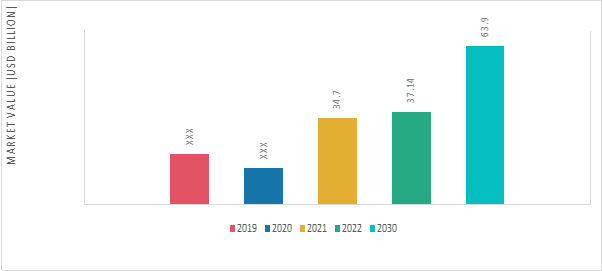
Air Compressor Market is expected to reach USD 63.9 billion
by 2030, growing at a CAGR of 7.02% between 2023 and 2030.
The rising demand for industrial air compressors from the oil and gas
industry and the rising demand for energy-efficient industrial air compressors
are expected to drive market growth during the forecast period.
Despite significant advances in alternative energy sources, market
demand for oil and oil-based products grows in lockstep with global population
growth.
Large and small businesses rely heavily on industrial compressors in
today's oil and gas industry. Furthermore, energy-efficient compressed air
solutions are becoming more popular with a growing emphasis on energy costs and
increased greenhouse gas (GHG) emissions. During the forecast period, increased
automation and rising urbanization in emerging economies are expected to drive
market growth.
For HVAC and other critical units used in compressors, manufacturing
industries around the world used to import compressors and their components
from China. However, due to the COVID-19 outbreak, Chinese vendors closed their
factories, temporarily halting production. Since the number of COVID-19 cases
in China has decreased, vendors with manufacturing plants in the region have increased
component prices by nearly 2-3% due to a supply shortage caused by factory
shutdown.
As a result, the entire supply chain from China has been impacted. The
COVID-19 spread has also fueled innovation in the compressors segment, with
vendors ramping up production to meet the unexpected surge in demand.
Market segmentation:
The global industrial air compressor market is
segmented based on pressure, seal, type and end-user.
According to the pressure:
- Above 100 bar
- 20 – 100 bar
- Up to 20 bar
According to the seal:
- Oil-Lubricated seal
- Oil-Free seal
According to the type:
- Positive displacement
- Dynamic
According to the end-user:
- Oil and gas industry
- Chemicals and petrochemical
industry
- Manufacturing industry
- Many others
Regional analysis:
The global industrial
air compressor market size has been divided
into the Middle East and Africa, Asia-Pacific, South America, North America,
Europe, and the rest of the world.
The Asia-Pacific region had the highest revenue share. The region saw a
surge in investments in the hydrogen and green energy sectors to meet its
energy demand while adhering to decarbonization policies. The demand for air
compressors in various applications, including food and beverage,
manufacturing, home appliances, and the oil and gas industries, propels the
market growth.
Furthermore, multiple manufacturers and Taiwan's significant electronics
and semiconductor manufacturing industrial base are likely to drive market
growth.
Furthermore, North America is expected to grow rapidly in the global
market. The growing number of industrial infrastructure projects and the
ongoing investment in all process sectors, particularly the oil and gas
industry, support market expansion across all industry domains. Furthermore,
IoT adoption, initiatives such as Industry 4.0, and technological breakthroughs
related to new product development are expected to boost market demand.
Recent developments:
- Gardner Denver and Ingersoll
Rand Industrial segment merged in March 2020 to provide a broader
portfolio of mission-critical industrial, more robust, medical, energy,
and specialty vehicle products and services.
- Atlas Copco acquired Dr.
Gustav Gail Drucklufttechnik GmbH, a German distributor of industrial
compressors and services, in February 2020.
Related Reports
Wireline Logging Services Market size
Reservoir Analysis Market size
Comments
Post a Comment